

Richard Eaton and Mackenzie Farrell

Executive Summary
In recent years, Berlineaton has conducted numerous Narrative 360 Reviews with senior leaders across industries. These deep, interview-based assessments—capturing input from peers, supervisors, direct reports, stakeholders, and even family members—offer a rare window into what people genuinely expect of an Ideal Executive Level Leader.
Our analysis of hundreds of comments from 54 interviewees, many of whom were themselves Executive-level leaders, reveals an unmistakable conclusion: today’s most effective executives are defined far more by their “People” capabilities than by traditional strengths in strategy or process. In fact, people-centric leadership qualities were cited seven times as often as strategic or operational attributes.
For executives working to elevate organizational performance, the message is clear: your effectiveness increasingly hinges on how you show up as a communicator, collaborator, and builder of trust. Strategic thinking and operational competence are necessary—but no longer sufficient. This article outlines the precise attributes modern leaders must embody across three dimensions: People, Direction, and Process.
The Narrative 360 Approach
Berlineaton supports organizations in strengthening their Direction, Process, and People. As part of our Executive Coaching services, we regularly conduct Narrative 360 Reviews—confidential interviews with 10–12 individuals who know the executive well. Insights from these conversations help leaders develop a clear understanding of how they are perceived and what is expected of them.
One consistent question we ask during every Narrative 360 is:
“In your opinion, what are the characteristics of the Ideal Executive Level Leader?”
Over several years, we collected hundreds of responses to this question. We consolidated the most recent feedback to understand current expectations for executive leadership.
What We Heard
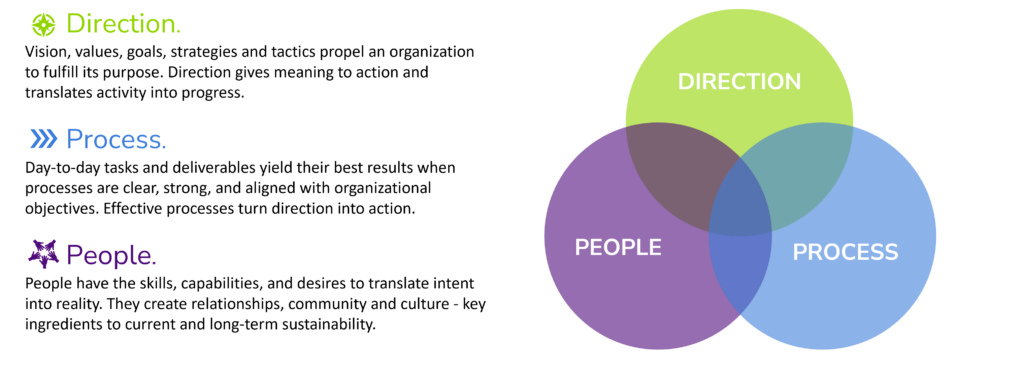
Using Berlineaton’s Dimensions of Organizational Effectiveness—Direction, Process, and People—we categorized all feedback into the leadership attributes most frequently cited.
1. People (70% of all Comments)
By a decisive margin, interviewees described the Ideal Executive Level Leader as people-centric. This emphasis reflects the increasing importance of emotional intelligence, communication, and trust-building at senior levels.
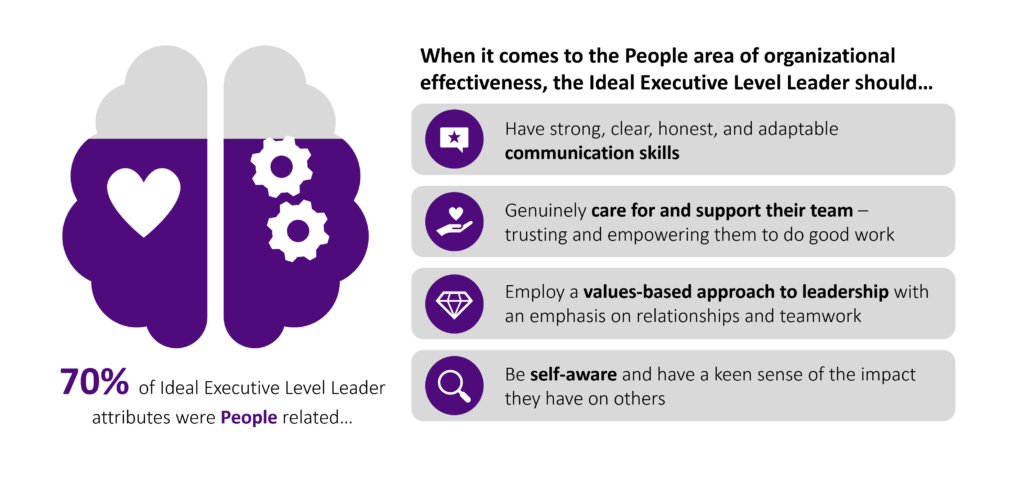
Exceptional Communication
The strongest and most consistent theme. Ideal Leaders:
- Communicate clearly, honestly, and directly
- Tailor messages to diverse audiences
- Engage authentically and visibly
- Convey passion for their work in a way that inspires
Genuine Care and Support
Interviewees repeatedly stressed the importance of leaders who:
- Are approachable, accessible, and supportive
- Listen actively and respect differing viewpoints
- Demonstrate compassion and empathy
- Trust and empower their teams rather than micromanage
Values-Based Leadership
Effective executive leaders:
- Lead through integrity, empathy, and authenticity
- Build relationships and nurture collaboration
- Provide calm, composed leadership during complex or stressful situations
Self-Awareness and Humility
Ideal leaders:
- Understand their impact on others
- Show vulnerability when appropriate
- Know when to ask for help
- Pursue continuous personal growth
2. Direction (20% of all Comments)
While still essential, Direction-related capabilities were mentioned far less frequently. Strategic thinking appears to be viewed today as a baseline competency rather than a differentiator.
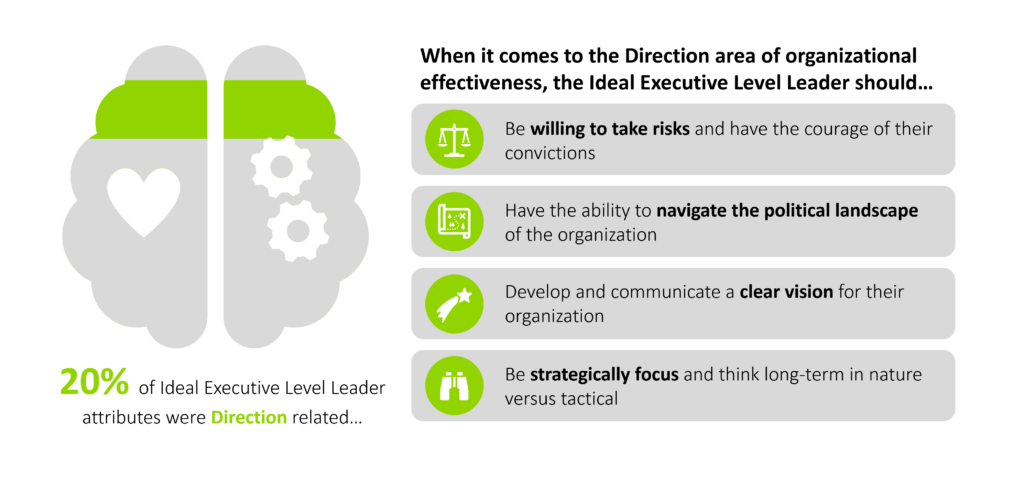
Responsible Risk-Taking
The most frequently cited Direction attribute. Ideal leaders:
- Have the courage to take calculated risks
- Lead their organizations confidently into new territory
- Make bold decisions grounded in sound judgment
Political Acuity
Executives are expected to:
- Navigate internal politics wisely
- Balance corporate priorities with staff needs
- Understand how decisions will land across the organization
Vision and Strategic Translation
Interviewees expect leaders who can:
- Develop and articulate a compelling vision
- Anticipate what’s coming next
- Translate high-level strategy into meaningful, actionable direction for teams
Strategic Focus
Although cited least within this category, it remains foundational. Ideal leaders:
- Prioritize effectively
- Stay focused on long-term, enterprise-level goals
- Use resources wisely and intentionally
Process (10% of all Comments)
As expected, operations and process-related attributes were mentioned least—reflecting the executive’s responsibility to lead through others rather than personally manage the mechanics.
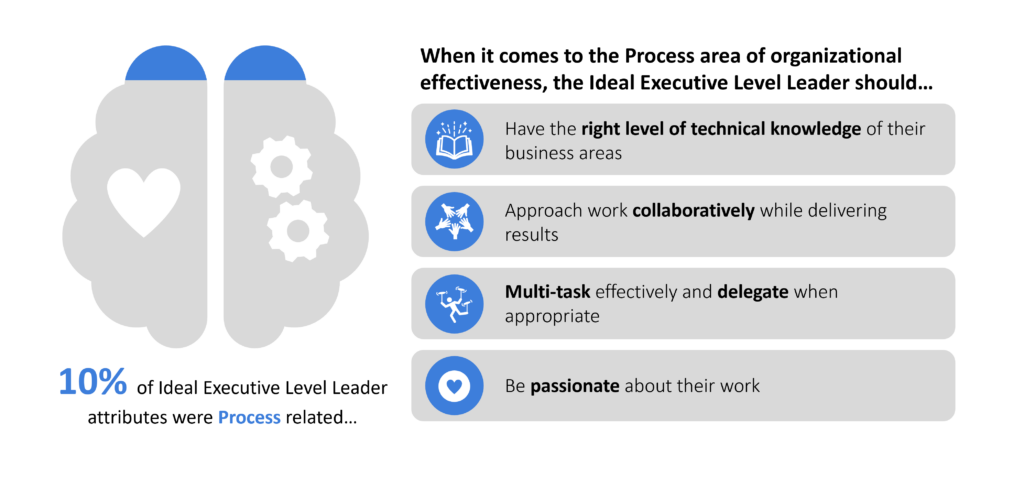
Technical and Operational Understanding
Ideal leaders:
- Possess sufficient technical knowledge to lead credibly
- Understand how work gets done without becoming mired in details
Collaborative, Results-Driven Delivery
Effective leaders:
- Facilitate team-based problem-solving
- Delegate appropriately
- Support innovation and creativity
- Maintain a passion for the work and its impact on clients and stakeholders
Conclusion: What This Means for Today’s Executives
When asked to describe the Ideal Executive Level Leader, stakeholders across all levels overwhelmingly focus on People-first leadership—outnumbering Direction and Process attributes nearly four to one.
Peter Drucker once noted that leaders must “treat almost anybody as a volunteer.” In today’s environment, where disengagement and optionality are at an all-time high, this insight has never been more relevant.
If your organization is struggling with engagement, trust, or cohesion, the feedback from our multi-year Narrative 360 analysis suggests a straightforward mandate:
Strengthen your People leadership.
Authentic communication, values-based leadership, trust-building, empathy, and self-awareness are what differentiate high-performing executives today—not just strategic insight or operational expertise.
Executives who invest in these qualities will not only elevate their teams’ performance but also enhance their own impact, credibility, and legacy.
Explore how Berlineaton’s people development services can strengthen your leaders and teams—visit our People Development Services Page to learn more about coaching, assessments, and HR advisory support.