


A Strategic Plan sets a school’s direction. But how do school leaders decide what to do first, what can wait, and how much they can realistically take on?
This is a common challenge we see in our work with independent schools. Even with clear and ambitious strategic priorities in a Strategic Plan, schools can struggle to gain momentum. Day-to-day operational demands compete for attention, resources are stretched, and leadership teams may have different views about where to begin.
Developing a Strategic Plan is only the first step. Making meaningful progress requires an equally thoughtful approach to implementation. Just as there is a methodology for strategic planning, execution requires clear priorities, accountability, regular progress reviews, and the flexibility to adjust as circumstances change.
One tool we use at Berlineaton is Planning Arcs, a practical framework for determining what needs to happen now, next, and later. Although we use it as part of our strategic planning process, schools can also apply it to existing plans or annual planning.
More Than a Timeline
For each strategic priority, Planning Arcs help leadership teams consider three timeframes:
- Now (next 12 months): What needs our attention first? What can we realistically accomplish with our current capacity?
- Next (12–24 months): What should we be building toward? What needs to be in place before we can move forward?
- Later (beyond 24 months): What longer-term initiatives require additional planning, investment, or preparation?
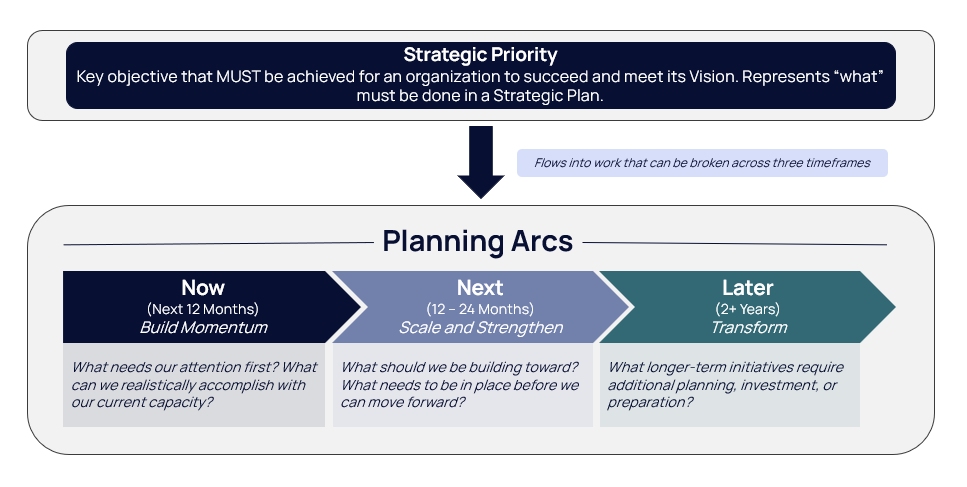
Once this exercise is completed for each strategic priority, it is important to step back and look at the Strategic Plan as a whole. Is the workload realistic? Is too much concentrated in one timeframe? Where could initiatives be spread out to better balance the work with available capacity?
Not every strategic priority needs to advance at the same pace. A school focused on student well-being, academic programming, and campus development, for example, may be ready to improve well-being programs immediately. Expanding academic offerings may first require research and consultation, while a major campus project could depend on several years of fundraising and financial planning.
The real value of Planning Arcs lies not simply in establishing timelines, but in the conversations and decisions required to develop them. When initiatives compete for resources, cross departmental boundaries, or prompt differing views, working through the arcs helps leadership teams reach a shared understanding of what matters most and what is realistically achievable.
Building Momentum Without Losing Flexibility
Having many initiatives underway does not necessarily mean a school is advancing its strategic commitments. Planning Arcs help teams maintain focus through realistic milestones and a shared view of progress, without treating the plan as a fixed schedule.
For example, changes in enrolment, finances, staffing, or community needs may call for adjustments. Revisiting the Planning Arcs during annual planning, at the start of a school year, or when circumstances change allows leaders to recognize accomplishments, identify emerging challenges, and make informed decisions about what comes next. It also provides a useful foundation for reporting progress to the Board.
Why This Matters Now
By November, leadership teams have a clearer picture of the demands of the school year. Some strategic priorities may be progressing as planned, while others have been displaced by immediate operational needs. This is a good time to ask:
- Are we making meaningful progress on our strategic priorities?
- Are we trying to accomplish too much at once?
- Are we aligned on what needs to happen first?
- What should we adjust to maintain momentum through the remainder of the school year?
The answers may not require a change in strategic direction, but rather a fresh look at how the work is prioritized and delivered.
How Berlineaton Can Help
At Berlineaton, we help independent schools bridge the gap between strategic ambition and practical implementation. Whether developing a new plan or strengthening an existing one, we facilitate the conversations that help leadership teams make informed trade-offs, align expectations, and agree on a realistic path forward.
Our independent perspective creates space for everyone, including the Head of School, to participate fully in these discussions. We also support schools in establishing accountability and practical ways to review progress and respond to challenges.
Our focus is not simply on creating a plan, but on building the alignment, discipline, and shared ownership needed to deliver meaningful strategic results.